


Garage Floor Coating & Epoxy Flooring in Fremont, CA
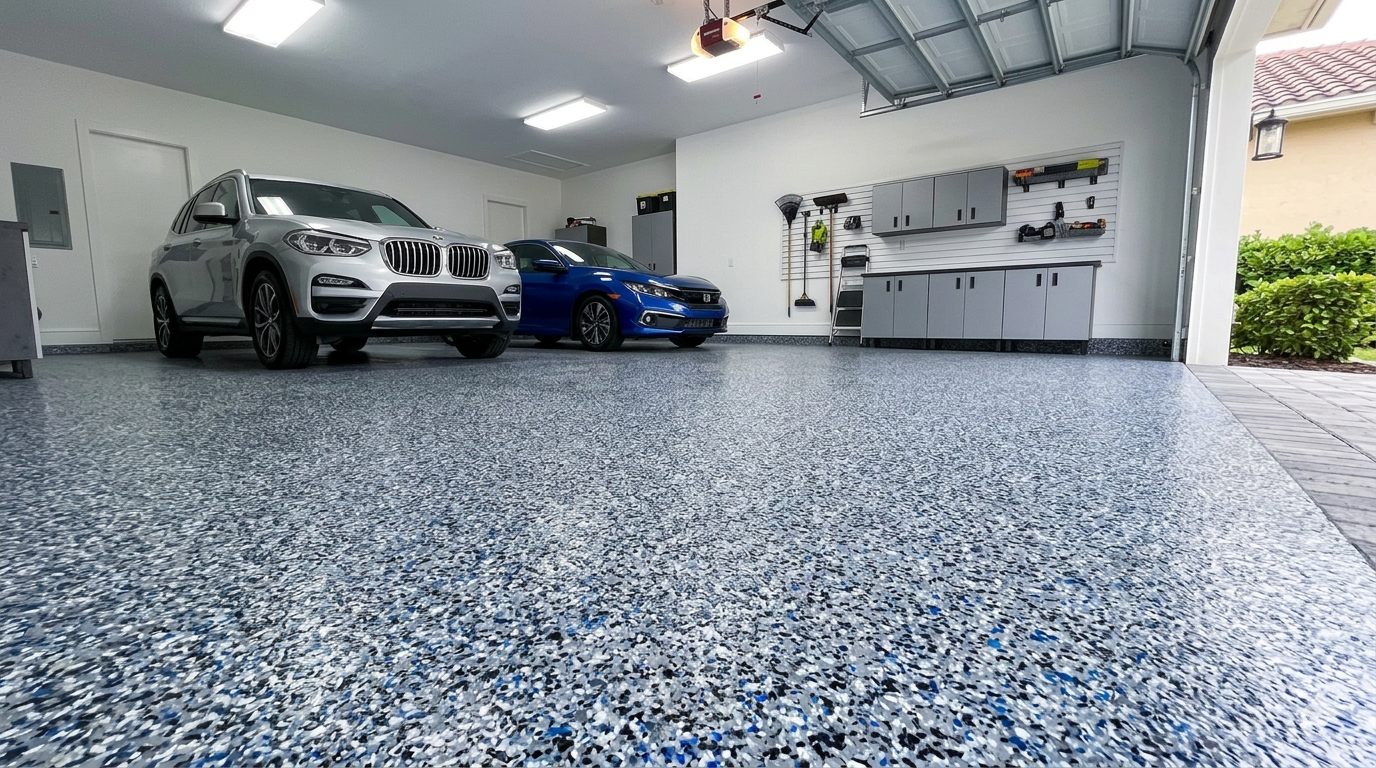

Precision Epoxy Flooring Fremont puts down garage floor coatings and garage epoxy flooring on homes across Fremont and its neighbors. We offer two garage systems, full-broadcast flake and solid color, each usually finished with a clear protective topcoat. We test the slab for moisture before we quote, we're licensed and insured, and the garage gets cleaned up once the job is done.
- Full-broadcast flake: vinyl flakes over a colored base coat, sealed under a clear topcoat.
- Solid color: one even color across the slab, with no flake.
- Moisture test first: the slab is tested before you get a price.
- Free estimate: no charge to look at your garage and quote it.
Prep Comes First on Fremont's Older Slabs
A garage coating is only as good as its bond to the concrete, and one coating maker calls surface preparation the single most critical factor in how an epoxy floor performs. Plenty of garages around town sit on concrete poured decades ago. According to the city's Housing Element, 32,139 homes in the city went up from 1960 to 1979, the busiest building period on record there, and the General Plan says most of the area around Centerville was developed in the 1950s, 60s and 70s on former farms and orchards.
On a slab that age, tire residue and any old coating have to come off before anything new goes down. Professional floors are prepared mechanically, by diamond grinding or shot blasting, until the concrete reaches a set roughness on the industry's ICRI concrete surface profile (CSP) scale. A flake system needs a rougher profile than a thin coating does: manufacturer data sheets for flake floors commonly ask for CSP 3 or more. Cracks and chipped areas are filled during this stage, so a damaged slab costs more to prepare than a sound one. That order of work, grind first and coat second, is the same for concrete coatings anywhere in the country, from the Bay Area to New England.
Full-Broadcast and Partial Flake Floors
A flake floor starts with a pigmented base coat. While it is still wet, vinyl flakes are broadcast across it. In a full broadcast, the flakes keep going down until the base color is completely buried, a point installers call “refusal.” In a partial (or decorative) broadcast, the flakes are scattered more lightly and the base color shows between them.
After the base coat cures, the loose flakes are scraped and swept away and a clear topcoat locks the rest in place. Quarter-inch flakes are the usual size for home garages, with smaller sizes chosen for showroom or interior floors. The texture of a full broadcast gives tires and shoes a little extra grip, and the flakes help hide small flaws in the concrete underneath.
Rainy-season grip: most of the area's rain falls between November and March, and cars bring it into the garage on their tires. Any smooth coated floor can turn slick when it's wet. A full broadcast flake floor has some texture of its own, and an anti-slip grit such as aluminum oxide can be added to the topcoat for more.
Solid Color Garage Coatings
A solid color floor skips the flakes: the slab gets one or more coats of colored epoxy, usually finished with a protective topcoat. Some owners choose it simply for a clean, plain look. Several published price guides also put solid color below a full broadcast, mainly because no flake goes down.
Solid floors are smoother than flake floors, so the anti-slip grit mentioned above matters more on them. If your garage also needs something more decorative, a metallic epoxy floor is a third option, though it sits higher on price.
Why We Moisture Test Every Slab
Water vapor moving up through concrete is one of the ways a new coating fails: it can cause blisters or make the coating peel away from the slab. We test every garage slab for moisture before quoting, so if a slab reads high, you hear about it at the estimate and not after the floor is down.
There are two standard tests. ASTM F1869 measures how much vapor the slab gives off, using a dish of calcium chloride set under a plastic dome on the slab, and ASTM F2170 reads the relative humidity inside the slab with probes set into drilled holes. Each coating maker publishes its own limits; two examples from manufacturer data sheets are 3 pounds per 1,000 square feet per 24 hours and 75% relative humidity. Above the limit, the maker calls for a moisture-mitigation primer or barrier under the coating.
Hot Tires and Summer Heat
Hot-tire pickup is a well-known garage coating failure: a car parks after a summer drive, the heat and plasticizers in its tires soften the coating, and it can lift or peel away from the concrete. Coating makers trace most cases back to poor preparation, and they name thin, low-solids coatings as the most likely to suffer.
At the Newark weather station, July and August highs averaged about 78°F over the 1971-2000 normals, and San Jose's station, closer to Milpitas, averaged about 84°F in July. Coating makers point to proper grinding and a correctly specified, full-thickness system as the main defense against hot-tire pickup, so those summer afternoons are a reason not to cut corners on prep.
Epoxy or Polyaspartic?
Many local installers now offer a polyaspartic topcoat over an epoxy base, and some offer polyaspartic systems throughout. The trade-off is mostly about time and sunlight. Polyaspartic cures much faster, often ready within hours rather than days, and it holds its color under UV, whereas epoxy tends to yellow when it sits in strong sun or bright light for long periods. Epoxy takes longer to cure.
For a garage that stays closed most of the day, either can work. If the door stays open for hours facing the afternoon sun, or you can't keep the car out for several days, raise it at the estimate.
Bay Area air rules: the Bay Area Air Quality Management District's coatings rule (Regulation 8, Rule 3) names garage floors in its definition of a floor coating. Since January 1, 2011, the rule (in its 2009 amended form) has capped floor coatings at 100 grams of VOC per liter.
What a Garage Floor Coating Costs in Fremont
Typical published prices in 2026 put a professionally coated two-car garage at about $1,500 to $6,500, and metallic floors or two-car garages on the large side can run higher. These are typical prices from cost guides and local sources, not ours; the free estimate gives the actual price for your garage.
- Garage epoxy, per square foot: about $4 to $12.
- Full-broadcast flake, per square foot: about $5 to $10.
- Grinding and surface prep, per square foot: about $1 to $4, with crack and spall repair on top.
Cost guides size a two-car garage at roughly 400 to 500 square feet. Beyond size, the price moves with the slab's condition (an old coating to remove or damage to repair both add prep time), the system you choose, and what the moisture test finds.
Garage Coatings Across the Five Districts
We coat garage floors in all five of Fremont's districts, the former townships of Mission San Jose, Warm Springs, Irvington, Niles and Centerville, and in Ardenwood in North Fremont. Outside town, we also work in Hayward, Union City, Newark, Milpitas and north San Jose. For the full range of floors we install, see our epoxy flooring page.
Garage Floor Coating FAQs
Short answers on cure times, cost, grip, cracks and how long a garage coating lasts.
How long until I can park on a new garage floor?
Epoxy data sheets typically allow walking on the floor after about 24 hours and driving on it after about 72 hours, with a full cure taking around a week. Those figures assume 70 to 80°F; December and January lows near the Bay average about 42°F, so winter jobs need longer.
How much does it cost to coat a two-car garage around Fremont?
Typical published prices for 2026 run about $1,500 to $6,500 for a two-car garage, or $4 to $12 per square foot, and more for metallic or bigger floors. The free estimate gives the figure for your garage.
How is a partial flake broadcast different from a full one?
A full broadcast covers the base coat completely in flakes, while a partial broadcast scatters fewer flakes so the base color shows through. Full broadcast uses more flake and gives the floor more texture.
Is a garage floor coating slippery?
Smooth coatings can be slippery when wet. Flake adds some texture, and an anti-slip grit such as aluminum oxide can go into the topcoat if you want more grip.
Can you coat a garage floor that has cracks?
Cracks and chipped areas are filled as part of surface prep before the coating goes down, and that repair adds to the cost. We'll look at the slab and tell you what it needs at the estimate.
How long does a garage floor coating last?
With good prep and regular care, a professionally installed epoxy floor commonly lasts somewhere between 10 and 20 years. Thin coatings or heavy traffic can cut that well short.
Are you licensed and insured?
Yes. The Contractors State License Board lets you look up any contractor licensed in California at cslb.ca.gov.
Still have a question?
Phone us on (510) 751-0658 with anything the answers above don’t cover.