


Epoxy Flooring Services in Fremont
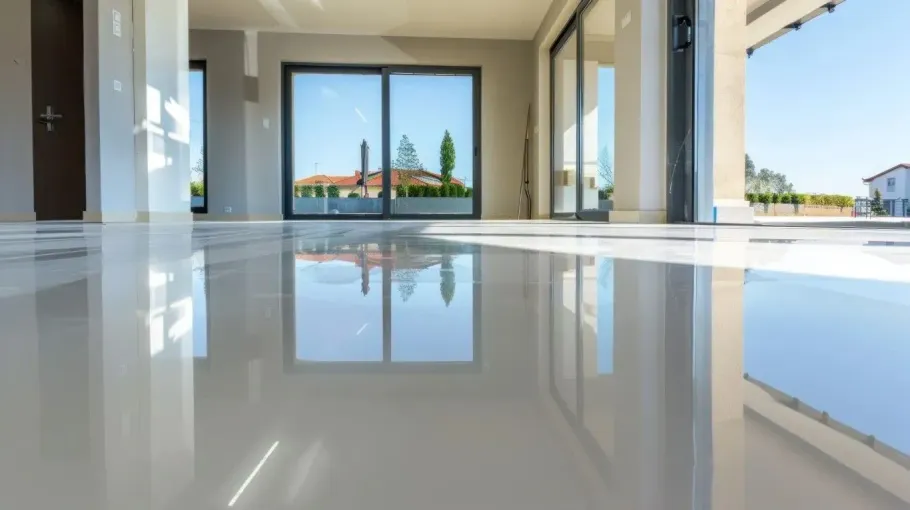

Precision Epoxy Flooring Fremont installs epoxy on four kinds of floor: garage floor coatings in flake or a solid colour, commercial epoxy flooring for working buildings, metallic epoxy, and coatings for interior rooms in a house. Three of them have a page of their own, linked in the cards below, and this page helps you match a finish to your space. Each slab gets a moisture test ahead of any quote, the estimate is free, and we hold a license and insurance.
- Garage epoxy flooring: a full-broadcast flake finish or one solid colour, with cracks fixed during prep.
- Commercial epoxy flooring: auto shops, warehouses, retail floors, food premises and light manufacturing.
- Metallic epoxy floors: swirled, one-off finishes for living spaces and retail interiors.
- Floors inside the home: living rooms and other interior spaces, including metallic finishes.
Garage Floor Coatings: Flake or Solid Colour
Garages are where many homeowners start. The area that became Fremont grew quickly after World War II: Census figures gathered by the Metropolitan Transportation Commission put the population at 43,790 in 1960 and 100,869 ten years later. According to the city's Housing Element, the 1960 to 1979 period produced a larger share of today's housing than any other. An older garage slab may carry cracks and old stains, and we fix cracks as part of prep before the coating goes on.
We offer two garage finishes. For full-broadcast flake, the wet base coat is covered in vinyl chips until no bare patches are left, the excess comes off with a scraper and broom once the base has hardened, and a clear topcoat locks in what remains. The chips leave a speckled surface with some grip. Solid colour is a single smooth shade. Professional systems call for the concrete to be ground to the profile the coating maker specifies; acid etching tends to leave a profile too shallow for most of them.
Commercial Epoxy Flooring for Working Buildings
Fremont has a lot of working floor. City economic development figures put the city's industrial space at 50 million square feet, over two-thirds of it inside the Bayside Industrial Zone, and Ardenwood Technology Park adds an R&D hub of roughly 3 million square feet, home to many life sciences companies. The General Plan says much of Bayside Industrial went up during the 1970s and into the early 1980s, typically in buildings of one or two storeys.
The right system and thickness for a business floor depend on what it has to cope with: forklift and pallet-jack lanes, oil or chemical spills, regular wet cleaning, people walking through. Warehouse and food-prep floors get fuller treatment on the commercial page.
Wet floors: smooth coated concrete can get slippery once it's wet. If water or spills come with the job, an anti-slip grit such as aluminium oxide can be added to the topcoat, and a flake finish brings some texture of its own.
Food businesses in Alameda County: before building or remodelling a retail food facility, operators need County Environmental Health to approve the plans, which set out the floor, cove base, wall and ceiling finish room by room. On the county's floor-finish list, epoxy paint is rated unacceptable, while a two-part epoxy resin pour no thinner than 1/4 inch is listed as generally acceptable. The county suggests contacting the District Inspector with any questions before a finish is bought or installed.
Metallic Epoxy and Floors Inside the Home
For a metallic floor, a clear epoxy is mixed with metallic pigment and worked with rollers and squeegees while it's still wet, which is why the swirls and veining never repeat from one floor to the next. It suits living areas and retail interiors. We coat other rooms in the house as well. Worth mentioning at the estimate: many epoxies yellow after long exposure to sunlight or strong artificial light, so let us know about big sunny windows.
Moisture Testing and Weather
Moisture vapour coming up through concrete is a leading cause of coating failure, leaving a new floor blistered or lifting, which is why each slab is tested before we give a price. Two standard tests are used. ASTM F1869 sets a calcium chloride dish on the surface to measure the vapour it releases; ASTM F2170 places probes inside the concrete to read its relative humidity. Coating makers commonly cap vapour emission at 3 lb for each 1,000 sq ft over a day, or relative humidity at 75%, and each product sets its own figure. Over the limit, a moisture-mitigation primer or barrier is called for.
Weather matters too. At the Newark station, the 1971-2000 normals show roughly 14.85 inches of rainfall a year, concentrated from November to March, with each month from June to September averaging 0.2 inches or less. Curing is slower in the cold, so in winter the floor may need longer before a car can go back on it.
Typical Epoxy Floor Prices in 2026
These are typical 2026 figures for the Bay Area, drawn from cost guides and local contractors. They're a guide rather than a quote: the real price comes from your free estimate once the floor has been measured and tested.
- Garage epoxy, professionally installed: about $4–$12 per square foot.
- Metallic epoxy: about $8–$15 per square foot, and custom designs can run above it.
- Standard commercial floors: about $3–$12 per square foot; heavy-duty industrial and food-plant systems may cost more than that.
Where We Work
Our work covers the whole city, including its five districts, the former townships of Niles, Centerville, Irvington, Mission San Jose and Warm Springs. That runs from homes near the Fremont BART station in the center of town to the Warm Springs/South Fremont station, the southernmost BART stop in Alameda County. Neighboring cities have their own pages: epoxy flooring in Newark, Union City and Milpitas, and we take on jobs in Hayward and north San Jose too. For an overview of the business, visit our epoxy flooring Fremont home page.
Common Questions About Our Services
Short answers before you call.
Should my garage have flake or a solid colour?
Flake leaves a speckled surface with a bit of texture; solid colour is one even shade. Both go over a prepared slab with any cracks repaired, so pick the look you prefer. We're happy to talk it through at the free estimate.
Do you test for moisture on every job?
Yes. We test each slab before quoting, since moisture rising through concrete is one of the main reasons a coating blisters or lifts.
Does a garage floor coating need a building permit?
Fremont's handout of permit-exempt work names painting, papering, tiling, carpeting and similar finish work. Floor coatings aren't on it, so ask the city's Building & Safety Division about your job.
How soon can I use the floor again?
That depends on the coating and the temperature. Many epoxies can be walked on after about a day and driven on after 48 to 72 hours, with a full cure in roughly a week, and all of it takes longer in cold weather. Ask about the times for your system at the free estimate.
Do you work outside the city?
Yes. Besides Fremont we cover north San Jose, Hayward, Milpitas, Union City and Newark.
Are you licensed and insured?
We are, on both counts. License details for any California contractor can be checked at cslb.ca.gov, the Contractors State License Board's site.
Is clean-up included?
Yes, every time: we sweep up and leave your space tidy before we head off.