


Metallic Epoxy Flooring in Fremont, CA
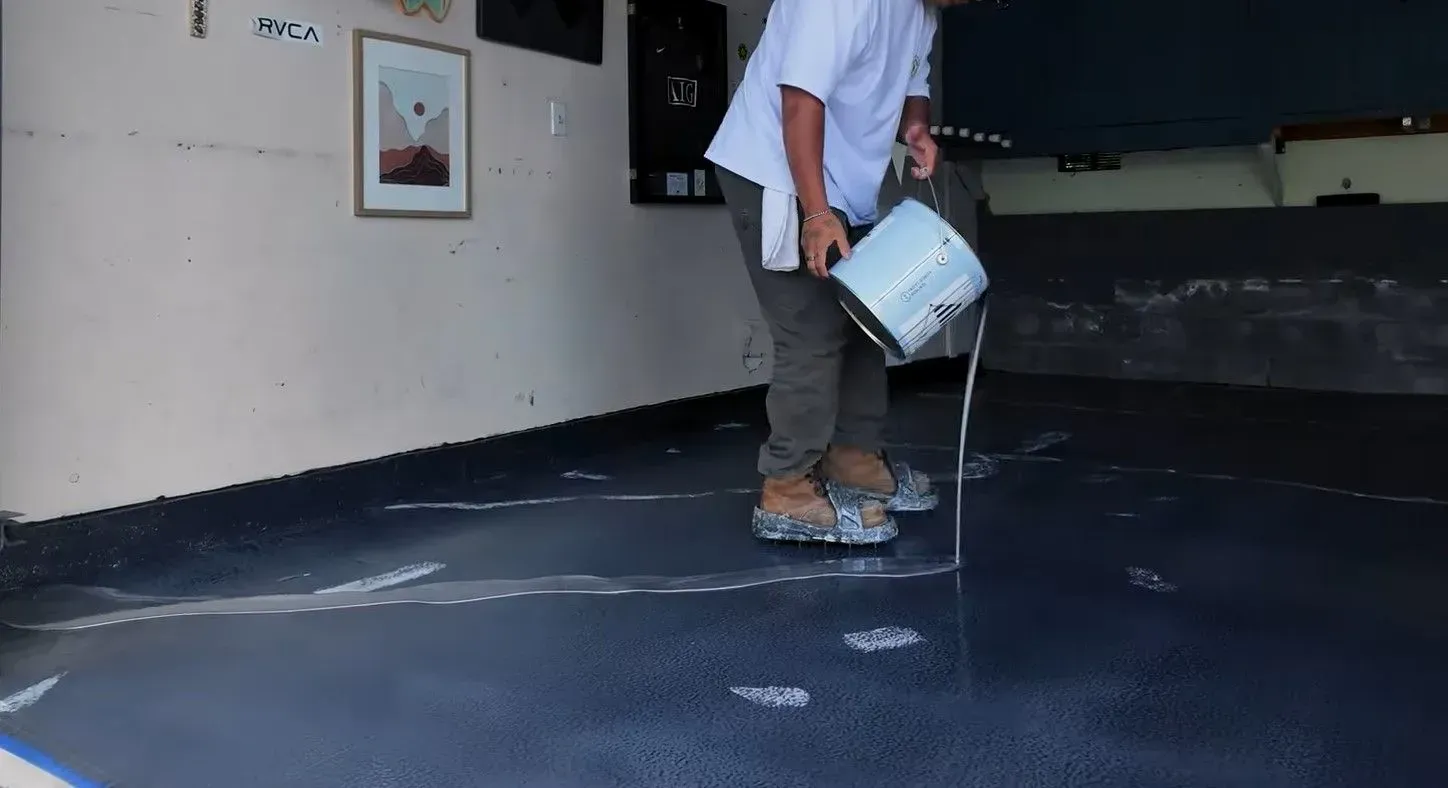

Precision Epoxy Flooring Fremont installs metallic epoxy flooring in homes, garages and business spaces across Fremont and in Union City, Hayward, Newark, Milpitas and north San Jose. A metallic floor is a clear epoxy carrying metallic pigment, poured over a colored base and worked by hand while it's wet, so the finish swirls and marbles across the floor. Every slab gets a moisture test ahead of the quote, and we clean up the work area when the job is done. We're licensed and insured.
- Home interiors: living rooms, entries and home bars where the slab is concrete under the old flooring.
- Show garages: a popular choice for a garage that's as much a showroom as a workspace.
- Showrooms and lobbies: a floor customers notice the moment they walk in.
- Free estimate: a look at the floor, a moisture test on the slab and a price for the job.
How a Metallic Floor Is Built
A metallic system goes down in layers. Sika's metallic system, for example, starts with an epoxy primer, follows it with a body coat of epoxy mixed with metallic powder and finishes with a clear urethane topcoat. The color of that first solid coat matters more than most people expect: Sika's data sheet notes that the primer color influences how the whole floor looks, and suppliers typically use a black or very dark base, because a lighter one gives much lighter colors.
The middle layer is where the pattern happens. Installers pour beads of one or more colors and move them while the epoxy is still wet, swirling them with a roller or spraying denatured alcohol to make the pigment spread. Some installers push it around with air as well. Good metallic epoxy then levels itself, so the surface settles smooth while the pattern stays in it.
Why No Two Metallic Floors Match
Because the pigment keeps moving until the epoxy sets, the same colors on two floors still give two different results, and manufacturers say so themselves. Product photos are only an approximation, and some experienced installers advise against portable sample boards because a board can't predict the floor. What you can choose is the base color, the metallic colors and the general character, such as soft marbling or strong veining. Sika also recommends test areas to settle how much metallic powder goes in, since that amount changes how intense the color looks. We can talk those choices through when you call or at the estimate.
Metallic Floors for Homes
Much of the housing here went up quickly. The city's Housing Element says more homes were built from 1960 to 1979 than in any other period, around 32,000 of them, and the General Plan describes the land around Centerville as mostly built out between the 1950s and the 70s, with low-density subdivisions where farms and orchards once stood. The Housing Element also says about 23,800 homes in the city are over 60 years old and may need substantial renovation. Where a room sits on a concrete slab, metallic epoxy can replace tired carpet, vinyl or tile with one seamless floor.
The old flooring comes up first. Sherwin-Williams calls full removal of ceramic tile at the start the more efficient and economical route, and points out that wood floors flex, which standard epoxy doesn't tolerate. Leftover mastic or glue is normally removed too, by grinding or with a chemical remover. In a garage, metallic is a popular choice for a show garage; for a hard-working one, our garage epoxy flooring page covers flake and solid color systems.
Moisture and Prep Before the Pour
A glossy metallic finish highlights irregularities underneath it, so the prep matters as much as the pour. Water vapor rising through concrete can make a new coating blister or lose its bond, so we run a moisture test on the slab before giving you a price. ASTM F1869 traps the vapor coming off the surface with calcium chloride under a dome; ASTM F2170 reads humidity with probes placed in holes drilled into the slab. Common manufacturer limits are around 3 pounds per 1,000 square feet per day on the first and 75% relative humidity on the second, though they vary by product; above them, a moisture-mitigating primer is called for.
The concrete is then diamond ground or lightly shot blasted to give the epoxy something to grip, typically to a surface profile of about CSP 2 to 3 on the ICRI scale for coatings like these. Cracks and damaged spots are dealt with before any color goes down.
Sun, Temperature and the Topcoat
Epoxy on its own tends to yellow under strong sunlight, so the clear topcoat does a lot of the work in a sunny room. Metallic systems are commonly finished with a clear urethane or polyaspartic topcoat, and urethane topcoats are sold specifically to protect the surface from UV, scratches and wear. Summers here are mild rather than scorching: at the Newark weather station (1971-2000 normals) average highs sit near 78°F in July and August, with the Bay moderating temperatures. Still, a living room with big west-facing windows gets hours of direct sun, and that's where the topcoat choice matters most.
Temperature also matters on the day of the pour. Sika's metallic data sheet asks for the slab and the air to be between 50 and 86°F, with the slab at least 5°F above the dew point. December and January lows at the same station average about 42°F, so a cold garage or an unheated addition may need warming before a winter install.
Bay Area air rules: most coatings sold for use in the region fall under the air district's (BAAQMD) Regulation 8, Rule 3 on architectural coatings. Its 2009 amendments cut the VOC cap for floor coatings to 100 grams per liter, taking effect on 1 January 2011.
Showrooms, Lobbies and Shops
For a business, a metallic floor is part of the first impression. It's a common choice for showrooms, shops and office lobbies, and there's no shortage of those nearby, from the Pacific Commons Shopping Center in the Bayside area to the research and development buildings of Ardenwood Technology Park in North Fremont. For warehouse aisles, kitchens and back-of-house areas, our commercial epoxy flooring page covers the tougher systems those spaces need.
Because of their high gloss, metallic floors show scratches readily, which is another reason the clear topcoat matters. Clear topcoats are re-applied as they wear, depending on how much traffic the floor sees.
Wet floors: like any smooth, glossy coating, a metallic floor can be slippery when it's wet. A fine anti-slip grit can go into the last coat, though suppliers note it can slightly lower the gloss. Tell us about entrances and any areas that get wet so we can talk through where grip matters more than shine.
Typical Metallic Epoxy Prices
Cost guides published in 2025 and 2026 put professionally installed metallic epoxy at about $8 to $15 per square foot, with custom designs costing more. Treat them as typical prices around the Bay Area in 2026 rather than our own; the free estimate is where your real figure comes from.
- Metallic epoxy, installed: about $8 to $15 a square foot.
- Custom or multi-color designs: can cost more than that range.
- Grinding or shot blasting the slab: roughly $1 to $4 a square foot, with crack and spall repairs extra.
- A whole two-car garage in metallic: can come in above the $1,500 to $6,500 that garage epoxy typically costs.
What moves the number is mostly the floor itself: its size, what has to come off it, how much repair the concrete needs and whether a moisture reading calls for a mitigating primer.
Metallic Epoxy Across the Southern East Bay
Metallic floors go in across every one of Fremont's five districts, the old townships of Niles, Centerville, Mission San Jose, Irvington and Warm Springs. Next door, we work in Newark to the west and in Union City and Hayward to the north, and across the Santa Clara County line in Milpitas and north San Jose. For our full range of floors, including garage and commercial work, see our main epoxy flooring in Fremont page.
Metallic Epoxy Flooring FAQs
Quick answers to what people ask most about metallic floors, from price to drying time.
How much does metallic epoxy cost per square foot?
Cost guides published in 2025 and 2026 put professionally installed metallic floors at roughly $8 to $15 a square foot, and custom designs can run higher. These are typical prices, not ours; the free estimate gives you the price for your own floor.
Can I see exactly what my floor will look like before you pour?
Not exactly. You pick the base color, the metallic colors and the style of movement, but the pigment shifts as the epoxy levels, so the final pattern is unique to your floor. Photos of other floors show the range, not a copy.
Will a metallic floor scratch?
Because of the high gloss, scratches show readily, which is why a clear topcoat is usually added to take the daily wear. That topcoat can be re-applied as it wears.
Can metallic epoxy go over tile or a wood floor?
Usually the tile comes up and the coating goes onto the concrete underneath, since that's generally the more efficient and economical route. Wood flexes, which standard epoxy doesn't handle well, so a wood floor needs a different approach.
Will it turn yellow in a sunny room?
Epoxy can yellow under strong sunlight. A clear urethane or polyaspartic topcoat over the metallic layer helps protect it, and it's worth raising for any room with a lot of direct sun.
How soon can we use the room?
On many epoxy products you can walk on the floor about a day after the last coat, with full cure at around a week in mild weather of 70 to 80°F. Colder rooms take longer, and furniture waits until the coating is ready for it.
Are you licensed and insured?
Yes. Any contractor's California license can be checked online at cslb.ca.gov, run by the state's licensing board.
Still have a question?
Picturing a metallic floor in one particular room? Call (510) 751-0658 and tell us about it.